My Blog List

Amazon Widget

Search This Blog

Friday, May 14, 2021

PROPERTIES OF SUBTRACTION.


Properties Of Subtraction:

1. Closure Property.

2. Commutative Property (or) Order property.

3. Associative Property.

4. Zero Property (or) Identity property .

5. Subtracting a number from itself.

6. Subtraction of 1.


1. Closure Property:

When a whole number is subtracted from another whole number, the difference is not always a whole number.

i.e; a – b = c , a whole number ; (a > b).

      a – b = -c , not a whole number ;( a < b).

Example:

 25 – 10 = 15 , a whole number. ( a > b ).

 5 – 15 = - 10 , not a whole number. ( a < b ).      


2. Commutative Property (or) Order Property:

In subtraction, the order in which the numbers are subtracted is important. i.e: Minuend, a  >  Subtrahend, b. ( a>b)


 i.e; ( a – b ) ≠ ( b – a ) ; a, b are whole numbers.

            65 – 35 = 30; 

            35 – 65 = -30.


3. Associative Property:

The subtraction of whole numbers is not associative.

i.e; if a, b, c are whole numbers, then in general:

a – ( b – c ) ≠ ( a – b ) – c .   

Example: let a = 40 ; b = 20 ; c = 10.

a – ( b – c ) =  40 – ( 20 – 10 ) = 40 – 10 = 30.

(a – b ) – c   = ( 40 – 20 ) – 10 = 20 – 10 = 10.

Therefore, a – ( b – c ) ≠ ( a – b ) – c.


4. Zero Property (or) Identity property:

In this property 0 is subtracted from a number.

When 0 is subtracted from a number gives the number itself.

i.e; a – 0 = a.

Here, Minuend    = Number = 30,

          Subtrahend = 0,

          Difference = Number itself = 30

Example: 30 – 0 = 30; 100 – 0 = 100; 

                   (- 5) - 0 = -5 ; ( -25) - 0 = -25.


5. Subtracting a number from itself:

If the number is subtracted from itself, the difference is Zero.

i.e; a – a = 0.

Here, Minuend = Number = 58,

          Subtrahend = Number itself = 58,

           Difference = Zero = 0.

Example: 58 – 58 = 0; 72 – 72 = 0.  


6. Subtraction of 1:   

When 1 is subtracted from a number, we get its Predecessor.

Example: 500 – 1 = 499; 499 – 1 = 498; 498 – 1 = 497.


Thursday, May 13, 2021

SUBTRACTION.


SUBTRACTION:

The sign of subtraction is minus(-).

The terms used in Subtraction are:

 a) Minuend b) Subtrahend c) Difference.

·       Minuend is the bigger number; the number from which a number is subtracted.

·       Subtrahend is the smaller number; the number to be subtracted.

·       Difference is the answer or the result of the subtraction.


Example:

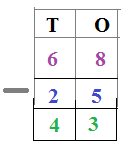
1. Subtract 25 from 68.

Solution:

Write the numbers in their respective columns.

Here, bigger number is Minuend i.e; 68.

The number to be Subtracted is Subtrahend i.e; 25.


Step1: Subtract the Ones: 5 Ones from 8 Ones = 3 Ones.

           Write 3 under Ones column. 


Step2: Subtract the Tens: 2 Tens from 6 Tens = 4 Tens.

     Write 4 under Tens column.


Thus, 68 – 25 = 43.


2. Subtract 241 from 463.

Solution:

Write the numbers in their respective columns.

Here, Minuend is 463, bigger number.

          Subtrahend is 241 , that is to be subtracted.


Step 1: Subtract the Ones: 1 Ones from  3 Ones = 2 Ones.

            Write 2 under the Ones column.


Step2: Subtract the Tens: 4 Tens from 6 Tens = 2 Tens.

           Write 2 under the Tens column.


Step3: Subtract the Hundreds:

2 Hundreds from 4 Hundreds = 2 Hundreds.

Write 2 under the Hundreds column. 


   Thus, 463 – 241 = 222.


Tuesday, September 1, 2020

Properties of Multiplication of Fractions.

PROPERTIES OF MULTIPLICATION OF FRACTIONAL NUMBERS:

The properties of multiplication of Whole numbers apply to the multiplication of Fractions as well.


1) The product of a Fraction and Zero is Zero.

    2/3  x  0  =   0;   3 5/4  x  0  =  0.


2) The product of a Fraction and One(1) is the Fraction itself.

     3/8  x 1 = 3/8;   4 7/3 x 1 = 4 7/3.


3) Two fraction can be multiplied in any order, the product remains the same.

    1/6 x  2/7 =  (1x2) / (6x7)  = 2/42  ;  2/7 x 1/6 = (2x1)/(7x6) = 2/42.


4) While multiplying more than two fractions, they can be grouped in any order. The product remains the same.

Let the fractions be:  2/5 x 1/7 x 2/3

2/5 x (1/7 x 2/3) = (2x1x2) / (5x7x3) = 4/105.

                    (or)                                                           

(2/5 x 1/7) x 2/3 = (2x1x2) / (5x7x3) = 4/105.

                   (or)

(2/5 x 2/3) x 1/7 = (2x2x1) / (5x3x7) = 4/105.

Therefore, 2/5 x (1/7 x 2/3) = (2/5 x 1/7) x 2/3 = (2/5 x 2/3) x 1/7 = 4/105.


Fill in the blanks using Multiplication Properties:

1) 3/8 x 6/7 =  6/7 x 3/8.

2) (1/5 x 4/6) x 2/9 =  1/5 x  (4/6 x 2/9).

3) 5/9 x 0 = 0.

4) 5/7 x 1 = 5/7.  

5) 3/7 x 2/7 = 2/7 x 3/7.

6)  6/5 x (3/7 x 4/5) = (6/5 x 3/7) x 4/5.    


Properties of Division of Fractions.

PROPERTIES OF DIVISION OF FRACTIONS:

 1) When a fraction is divided by 1, the quotient is the fraction itself.

   2/5 ÷  1 = 2/5 ;    3/7 ÷ 1 = 3/7 ;   2  3/5  ÷ 1 =  2 3/5.


2) When Zero is divided by a fraction, the quotient is always Zero.

  0 ÷ 2/5  =  0 ;   0 ÷ 3 4/5 =  0 ;   0 ÷ 3/8  =  0.

Note: We cannot divide a fraction by Zero.


3) When a fraction is divided by itself, the quotient is One (1).

  2/5 ÷ 2/5 = 1 ;   3 4/5 ÷ 3 4/5 = 1  ;  3/7 ÷ 3/7 = 1.


Fill in the blanks using properties of division:

1)  4/7 ÷ 4/7 =

2)  3/8 ÷ 1 = 3/8.

3) 4/9 ÷  4/9 = 1.

4) 0 ÷ 5/9 = 0.

5) 0 ÷ 2/9 = 0.


Friday, August 21, 2020

Division of a Fractional number by a Whole number.

DIVISION OF A FRACTION BY A WHOLE NUMBER:

Steps to find Division of fraction by a whole number:

i) Find out the reciprocal of the Whole number.

ii) Multiply the Fraction with reciprocal of the Whole number.

iii) Simplify into its lowest terms.

Required Answer = Fraction x Reciprocal of the Whole number.


Solve the Following:

1) 5/9 ÷  4

Solution :

Given: Fraction = 5/9 ; Whole number = 4.

i) Reciprocal of the Whole number = 1/4

Required Answer =  Fraction x Reciprocal of the Whole number

                             =  (5/9)  x  (1/4) =  5/36.           


2) 5/6 ÷ 4

Solution:

Given: Fraction = 5/6 ; Whole number = 4.

Reciprocal of the Whole number = 1/4

Required Answer =  Fraction x Reciprocal of the Whole number

                             =  (5/6) x (1/4) =  5/24.


3) 3/7 ÷ 3

Solution:

Given: Fraction = 3/7 ; Whole number = 3.

Reciprocal of the Whole number = 1/3.

Required Answer =  Fraction x Reciprocal of the Whole number

                             =  (3/7) x (1/3) = 7.


Division of a Whole number by a Fraction.

DIVISION OF A WHOLE NUMBER BY A FRACTION:

Steps to find Division of whole number by a fraction:

i) Find out the reciprocal of the fraction.

ii) Multiply the whole number with reciprocal of the fraction.

iii) Simplify into its lowest terms.

Required Answer = Whole number x Reciprocal of the Fraction.


Solve the following:

1) 8 ÷  1/5

Solution:

Given: Whole number = 8; Fraction = 1/5.  

i) Reciprocal of the fraction = 5.

ii) Multiplying whole number with reciprocal of the fraction.

  8 x 5 = 40 , required answer.        


2) 5 ÷   1/6

Solution:

Given: Whole number = 5 ; Fraction = 1/6.

Reciprocal of the fraction = 6.

Required Answer = Whole number x Reciprocal of the fraction.

                                =  5 x 6 = 30.


3) 9 ÷  2/3

Solution:

Given: Whole number = 9 ; Fraction = 2/3.

Reciprocal of the fraction = 3/2.

Required answer = Whole number x Reciprocal of the fraction.

                             = 9 x  (3/2) = 27/2.


4) 4 ÷ 2/3

Solution:

Given: Whole number = 4 ; Fraction = 2/3.

Reciprocal of the fraction = 3/2.

Required answer = Whole number x Reciprocal of the fraction.

                             = 4 x (3/2) = 6.


Division of Fraction by a Fraction.

DIVISION OF FRACTION BY A FRACTION:

Steps to find the result when a fraction is divided by another fraction:

i) Write the divisor in terms of its reciprocal.

ii) Multiply the dividend with reciprocal of the divisor.

iii) Simplify into its lowest terms.

Required Answer = Dividend x Reciprocal of the Divisor.


Solve the following:

1)  15/6  ÷  3/4

Solution:

Given: Dividend = 15/6 ; Divisor = 3/4

i) Reciprocal of the Divisor = 4/3.

ii)   Required Answer =  Dividend x  Reciprocal of the divisor

                                       =  (15/6)   x  (4/3)

iii) Simplifying into its lowest terms:

=  (15x4) / (6x3) = (5x2) / 3 = 10/3.


2)  21/28  ÷  3/7

Solution:

Given: Dividend = 21/28 ; Divisor = 3/7

Reciprocal of divisor = 7/3.

Required Answer = Dividend x Reciprocal of the Divisor 

=  (21/28) x (7/3) = (21x7) / (28x3)

 = 7/4.   ( simplify into Lowest terms :  3x7  /  4x3 =  7/4 )


3)  2 4/5  ÷  7/2

Solution:

Given: Dividend =  2 4/5 ; Divisor = 7/2

Converting Dividend: mixed fraction into fraction

2 4/5 = 14/5.

Reciprocal of the Divisor = 2/7.

Required Answer  =  Dividend x  Reciprocal of the divisor 

                                = 14/5  x  2/7  =  (14x2) / (5x7) =  4/5.


4) 8/9 ÷  5 1/3

Solution:

Given: Dividend = 8/9 ; Divisor = 5 1/3

Converting Divisor(mixed fraction)  into Fraction:

 5 1/3 = 16/3.

Reciprocal of the Divisor = 3/16.

Required Answer = Dividend x  Reciprocal of the divisor 

                               =  (8/9)  x  (3/16)  =  (8x3) / (9x16)  

                               =  1/6.


Thursday, August 20, 2020

Multiplication of a Whole number by a Fractional number.

MULTIPLICATION OF A WHOLE NUMBER BY A FRACTIONAL NUMBER:

Steps to multiply a whole number by a fractional number:

i) Write the whole number as a fractional number.

ii) Multiply the numerators of the fractions.

iii) Multiply the denominators of the fractions.

iv) Simplify into lowest terms.


Find the Product:

1) 10 x  3/5

Solution:

Given: whole number = 10 ; fraction = 3/5.

Required product = 10/1 x 3/5 = (10x3) / 5 = 30/5 = 6.

2) 16 x  5/4

Solution:

Given: Whole number = 16 ;  fraction = 5/4.

Required Product = 16/1  x  5/4 =  ( 16x5 ) / 4 = 20.


3) 6 2/7  of 7.

Solution:

Given: Whole number = 7; mixed fraction = 6 2/7.

Converting mixed fraction into fraction:

((Whole number x denominator) + numerator ) / denominator.

Whole number = 6 ; numerator = 2 ; denominator = 7.

 6 2/7 = 44/7.

Required Product = 7 of  44/7 =  7 x  44/7  

                              = ( 7/1  x  44/7 ) = 44.


4) 1 1/15  of  15

Solution:

Given: Whole number = 15 ; Mixed fraction = 1 1/15

Converting mixed fraction into fraction:

1 1/15 = 16/15.

Required Product = 15  of  16/15  =  15 x  16/15

                              = ( 15/1  x  16/15 ) =  16.


5)  5 1/5 of 10.

Solution:

Given: Whole number = 10; Mixed fraction = 5 1/5.

Converting mixed fraction into fraction:

5 1/5 = 26/5.

Required Product = 10 of  26/5 = 10  x  26/5

                              = ( 10/1  x  26/5 ) = 2 x 26 = 52. 


Wednesday, August 19, 2020

Multiplication of Fractions.

MULTIPLICATION OF FRACTIONAL NUMBERS:

Steps to Multiply Fractions:

i) Multiply the numerators of the given fractions, which is the new numerator.

ii) Multiply the denominators of the given fractions, which is the new denominators.

iii) Simplify the obtained new numerators and denominators into its Lowest terms, if required (cancel out the common factors wherever possible) .


Solve the Following:

1)  5/8  x  8/15

Solution:

Given: Numerators = 5, 8 ; Denominators = 8, 15.

New numerator =  5 x 8 = 40.

New Denominator = 8 x 15 = 90.

Thus, required Product is = 40/90 = 4/9.


2)  26/33 x 22/39

Solution:

Given: Numerators = 26 , 22 ; Denominators = 33, 39.

Required Product =  (26x22) / (33x39) ; reducing into lowest terms.

                           = 4/9;  (26/39 = 2/3 ; 22/33 = 2/3; Thus: (2/3) x (2/3) = 4/9).


3)  (2/11) x  (3 /4).

Solution:

Given : Numerators = 2, 3 ; Denominators = 11, 4

 Required Product = (2x3) / (11x4) ; reducing into Lowest terms

                               =  (1x3) / (11x2)  ( Since : 2/4 = 1 /2)

                              = 3 / 22.


4)  1/5  x  3/ 4

Solution:

Given: Numerator = 1, 3 ; Denominator = 5, 4.

Required Product =  (1x3) / (5x4)

                                = 3 / 20.


5)  7/7 x  2/6

Solution:

Given: Numerator = 7, 2 ; Denominator = 7, 6.

Required Product = (7x2) / (7x6); reducing into lowest terms.

                               = 1/3.  (7/7 = 1; 2/6 = 1/3; Thus: 1 x 1/3 =1/3).


Education Related Books

Society and Social Sciences Books

Maps and Atlases Books

Textbooks and Study Guides